Category: Galleries
-
The Priestly Garments
The garments of both the ordinary priest and High Priest are one of the most interesting topics of Temple study. Our day has seen the restitution of the biblical colors, ancient weaving techniques and understanding. Today these garments for the first time in almost two thousand years are now being made. In the case of the High Priest the garments are constructed.

Remembrance Stones 


[one_fourth]


-
The Kohen Gadol and the Officers of the Temple
To understand the function of the Kohen Gadol as well as the other Kohanim it is helpful to see the layout from which they operated.

This building housed the Lishkat haGazit (Chamber of Hewn Stone where the Sanhedrin Gedolah sat, the Lishkat haEitz (Chamber of the Wood – the quarters for the High Priest), the Beit Kior (House of the Laver) Beit Osei Chavittim (House of the Pancake Offering Bakery), Chambers for the singers and more. 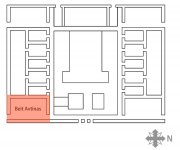
This building housed the Lishkat haGazit (Chamber of Hewn Stone where the Sanhedrin Gedolah sat, the Lishkat haEitz (Chamber of the Wood – the quarters for the High Priest), the Beit Kior (House of the Laver) Beit Osei Chavittim (House of the Pancake Offering Bakery), Chambers for the singers and more. 
This building directly behind the Temple Building was were some of the offerings pf the Kohanim were kept. 
In this building there were chambers that held salt for the Korbanot, a room for processing the hides of the Korbanot for the Kohanim, and a washing chamber for rinsing the hides, a flame was kept in the building in case the fire of the Altar went out. There was a special Chamber known as the Beit Even (House of Stone) where the kohen who was going to slaughter the Red Heifer stayed the week before the ceremony. 
This was the chamber where the kohanim on duty for the week slept. The two lambs for the daily Tamid were kept in the southwestern corner of the building. The Bakery for the Lechem haPanim (Bread of the Face was in the southeastern corner). The Chamber of the Tokens was in the northeastern section. In or beneath this chamber was where the stones of the desecrated altar were kept. 


The High Priest’s quarters were called by different terms, the Lishkat haEitz and the Lishkat Palhedrin/Parhedrin. As indicated before these were within the Beit Avtinas.
-
The Inner Courtyard according to Rambam


The two T shaped cisterns are mikvaot. It is thought that the smaller of the two was for women. Just below the smaller mikvah is a grid of conduits. Thesee are believed to be toilets. There is a separation between the conduits were the building was obviously divided into two sections. The smaller section is believed to be for women. 


Note the columns within the Parbar. 
The wall to the right is the Ulam (Porch) of the Temple. 

This building directly behind the Temple Building was were some of the offerings pf the Kohanim were kept.
This was the chamber where the kohanim on duty for the week slept. The two lambs for the daily Tamid were kept in the southwestern corner of the building. The Bakery for the Lechem haPanim (Bread of the Face was in the southeastern corner). The Chamber of the Tokens was in the northeastern section. In or beneath this chamber was where the stones of the desecrated altar were kept.
In this building there were chambers that held salt for the Korbanot, a room for processing the hides of the Korbanot for the Kohanim, and a washing chamber for rinsing the hides, a flame was kept in the building in case the fire of the Altar went out. There was a special Chamber known as the Beit Even (House of Stone) where the kohen who was going to slaughter the Red Heifer stayed the week before the ceremony. This building housed the Lishkat haGazit (Chamber of Hewn Stone where the Sanhedrin Gedolah sat, the Lishkat haEitz (Chamber of the Wood – the quarters for the High Priest), the Beit Kior (House of the Laver) Beit Osei Chavittim (House of the Pancake Offering Bakery), Chambers for the singers and more. 
First Temple Period this building was called Beit Yair haLevanon (House of the Forest of Lebanon. 


In the Tractate Negaim of the Mishnah we are told that there was a Mikvah below the Lishkat haMetzoraim. This chamber was on the northwestern corner of the Ezrat Nashim. 
This is an example of one of the signs in Greek. Josephus states they were in Greek and Latin. Two signs in Greek have been discovered. 
The Mishnah states that the wall was 10 handbreadths high, while Josephus states it was 3 cubits high. Both are correct. 
Note the Monumental Stairway as well as plaza between buildings. 
This diagram shows measurements from Cheil to Corner Buildings. 
This is a piece of a sign housed in the Israel Museum. It is 19.2 inches high. That equals 1 five handbreadths cubit. 
note on the left the two structures in front of the Royal Stoa. These are the exits for the Chuldah passageways. Then the Wall for the original Temple Mount, the Mikvaot and Toilets followed by the Soreg. The fourth chapter of Hilchot Beit haBechirah by Rambam describes the Temple building while Chapter Five lists the structures of the Azarah or Inner courtyard. In this Rambam mostly follows the information provided in Middot of the Mishnah. Several areas of his commentary need to be amended to provide a better view of the Azarah.
1) There are additional structures not listed by Rambam found in the Tanach, other texts of the classical Oral Torah (such as other buildings and chambers referenced in other tractates of the Mishnah, Tosefta, Talmud Bavli and Talmud Yerushalmi). Also throughout the Tanach many buildings are mentioned that are not described here. You must be careful to determine the exact location of a structure as it was common for buildings, chambers, and gates to have more than numerous names defining either different time periods or multiple functions of buildings. Josephus provides the names and locations of several of these. The Temple Scroll (from the Dead Sea Scrolls) describes many structures that are not listed in Middot or Hilchot Beit haBechirah).
2) Rambam lists seven gates to the Azarah as described in Middot. However, Middot also lists the number of gates to the Azarah as five and thirteen while Josephus describes both eight and nine gates. All these listings are essentially correct and are described according to different functions that are being expressed. Basically it deals with perspective. There were a total of thirteen gates to the Azarah.
3) Rambam states there were six chambers (Lishkot) to the Azarah. In fact there were numbers of other chambers to the Azarah. These six chambers are in reference to two of the corner buildings. The three chambers Rambam describes on the south are actually on the north and those Rambam lists on the north are on the south. The southern chambers are within the Beit Avtinas on the southeast corner and the northern chambers are within the Beit haNitzotz on the northeast corner. Rambam reversed the order of these chambers as listed in Middot due to a comment made in Pesachim 19a of the Talmud Bavli. From other texts we are able to determine that the listing in Middot was correct.
4) The Cheil is described by Rambam as a wall. Rather it was a pavement ten cubits wide that surrounded the Azarah. It is the stabilizing level that is equal on all sides. The Azarah continually goes up from this point so the Cheil provides both a common area to the Azarah and gives a base that you calculate all rises in elevation from.
With the above understandings and corrections, the work of Rambam is extremely valuable primarily to a concise reading of the order of the structures of the Azarah
-
The Altar of the Temple
From the various texts of the Tanach, Mishnah, Tosefta, Talmud Bavli, and Talmud Yerushalmi, Rambam has collected the assorted halachot of the Altar in a concise presentation. These are found in Chapter Two of Hilchot Beti haBechirah of the Mishneh Torah. This illustration allows you to see the Altar from different points of view allowing you to understand the halachot.


With Kohen on Saviv of Altar a perspective is gained. -
The Problem of the Kior

To understand the layout of the Temple and to recover the Tavnit (blueprint) 0f the Holy Temple is required to attempt the building of the Temple in our day. This is also critical to our understanding of Hashem’s word. The tavnit must agree with the text of scripture, halachah and function. The classic example of this is the case of the Kior or Laver.
The Kior (Laver) was the basin by which the kohanim sanctified their hands and feet before ascending the Mizbeiach (Altar) or entered the Beit haMikdash (Temple Building). Specifically, the kohanim had to sanctify their hands and feet before beginning the sacrificial service. According to the Temple Scroll, one of the Dead Sea Scrolls, the kohanim were also required to wash their hands and feet, due to the sanctity of the blood they would have on their garments and body, at the conclusion of their sacrificial service. During the First Temple period the Kior was known as the Yam (Sea). Middot states that the Kior was located between the Ulam (Porch of the Temple Building) and the Mizbeiach (Altar) toward the south.
The basin was between the ulam and the altar, drawn towards the south. Between the ulam and the altar were 22 amot. . . .
Middot 3.6The first impression from Middot 3.6 is that the Kior sat within the 22 amot between the eastern wall of the Ulam (the Porch of the Temple) and the western wall of the Mizbeiach (Altar). However, there are problems with this concept. These are described below.
Description of the Mukni of ben Katin
The Mukni (Machine) is often described as a type of crane that hoisted and lowered the Kior into a cistern. The Kior was make of bronze or brass. Water that remained overnight in a vessel made of bronze or brass became impure. Therefore, many scholars have interpreted that the Mukni lifted the kior after it was emptied and lowered it into a cistern for overnight. Immersing the vessel into a cistern with a large volume of water eliminated the possibility of impurity. The Kior (Basin) was raised the following morning by the kohen (priest) who was selected to clear the Mizbeiach (Altar).Frequently the Mukni (Machine) is represented as a wheel (Galgal) or pulley system attached to the Ulam (Porch) of the Beit haMikdash (Temple Building) that lowered the Kior (Basin) into a cistern located between the Ulam (Porch) and the Mizbeiach (Altar).
The traditional theory of how the Mukni worked and where it was located is not possible. These two points may be discerned from the Mishnah as well as the location of the cisterns of the Azarah.
The one chosen to pick up from the altar (Mizbeiach), he would pick up from the altar (Mizbeiach). And they would say to him: Beware, lest you touch the utensil before you wash your hands and feet from the basin (Kior)! And behold the shovel is placed on the corner, between the ramp (Kevesh) and the altar (Mizbeiach), on the west side of the ramp (Kevesh)! No man entered with him, and there was no candle in his hand; rather, he would walk by the light of the pile. They did not see him, nor did they hear his voice, until they heard the sound of the wood, that Ben Katin made as a mukhni for the basin, and they would say: The time has come! He washed his hands and feet from the basin (Kior), took the silver shovel, and went up to the top of the altar (Mizbeiach), and pushed aside the coals this way and that way. He shoveled out from the burnt up inner ones, and went down, He reached the floor, turned his face to the north, walked alongside the east of the ramp (Kevesh) about ten amot (cubits). He piled up the coals on the floor, three tefahim (handbreadths) away from the ramp (Kevesh), in the place where they put the bird crops, and the ashes of the inner altar (Mizbeiach Zahav) and of the menorah.
Tamid 1.4The expression “no man entered with him” indicates that the kohen must have entered a structure and there activated the Mukni (Machine). As no one was able to see him, this must have been a building. There was no structure between the Ulam (Porch) and the Mizbeiach (Altar). Even though it was dark as it was prior to dawn, the area was well lit by the fires of the Mizbeiach (Altar). It is also obvious that the Mukni (Machine) could be activated by a single individual. Therefore, the Mukni (Machine) must have been within a chamber inside this building.
The mishnah above also refers to the other kohanim in addition to the one who entered the building hearing “the sound of the wood, that Ben Katin made as a mukhni for the basin (kior). This naturally calls to mind the Galgal (Wheel) of the Lishkat haGolah (Chamber of the Returnees). Could the Galgal of the Lishkat haGolah be the same Galgal of the Mukni (Machine) of ben Katin? One is a machine to supply water to the kior, while the wheel within the Lishkat haGolah was used to supply water to the entire Azarah.
The Mukni (Machine) of ben Katin was described as a wooden machine that is usually thought of as a pulley that lowered and raised the Kior (Basin) each evening and morning. This strongly suggests that the wood of the Mukni (Machine) and the wheel (Galgal) of the Lishkat haGolah (Chamber of the Exile or Returnees) were the same. This would mean that the Mukni (Machine) would have been located within the Lishkat haGolah (Chamber of the Exiles or Returnees).
The very name of the chamber has been the subject of controversy. A note from the Kehati Mishnah Middot where this chamber was being discussed is helpful.
The chamber was named golah because the returnees from the Babylonian exile dug the well. (Bartenura). Others relate golah to galgal (“wheel” or “pulley”), i.e., the chamber was named after the pulley which lowered the basin (kior) into the well at night (Raviah cited by Tosefot Yom Tov). Some pronounce this word as gulah (bowl; cf. “and a bowl upon its top”; Zech. 4:2), i.e., a large round bowl which held the water drawn from the well (Tiferet Yisrael); cf. the variant reading: “Where there was a well with a fixed bowl, and a wheel placed over it” (Rabbenu Yehonatan cited by Tosefot Yom Tov).287
There is another reason why the traditional theory will not work. It is impossible to lower a vessel into a cistern as there are no cisterns or subterranean openings in that area. The nearest cistern to the Mizbeiach (Altar), the Kevesh (Ramp of the Mizbeiach) and the Ulam (Porch), is cistern #28 according to the map of Conrad Schick of the Palestine Exploration Fund. In addition, this present day cistern was not a cistern in the time of the Temple but rather a tunnel system thought to sit over the actual Bor Golah (Cistern of the Golah). For the Kior to have been located in the traditional spot (the 22 amot between the eastern edge of the Ulam and the western side of the Mizbeiach (Altar) would required a crane to lift the Kior (Laver) through the colonnaded Achsadrah (Portico) surrounding the Azarah and lower it to the tunnel beneath the Beit Avtinas (House of Avtinas) from which it would still have to have been lowered from the tunnel to the actual Bor Golah (Golah Cistern). This in turn was raised the next morning by a single kohen and returned to its place. Another matter would be that the weight of the Kior filled with water and then shifted to its position in the Azarah proper would have exceeded the technology of the time.
The solution is that the Kior was not located within that 22 amot. The requirement was that the Kior sat between the Ulam and the Mizbeiach. By comparing a mishnah from Kelim which lists progressively the different levels of sanctification within the Temple, an enlarged measurement for the area between the Ulam and the Mizbeiach is revealed.
Within the walls is more sanctified than these, for we may eat there kodashim kalim and ma’aser sheni (second tithe). Har Habayit is more sanctified than this, for zavim and zavot, niddot and yoldot may not enter there. The Heil is more sanctified than this, for Gentiles, and one rendered impure by a corpse, may not enter there. Ezrat Nashim (Court of the Women) is more sanctified than this, for a tevul yom may not enter there, but they are not liable to a sin-offering for it. Ezrat Yisrael (Court of Israel) is more sanctified than this for one lacking atonement may not enter there, and they are liable to a sin-offering for it. Ezrat Kohanim (Court of the Priests) is more sanctified than this, for Israelites may enter there only at a time when they are needed, for laying hands, for slaughtering, for heaving.
Kelim 1.8Between the Ulam and the altar is more sanctified than this, for those with a blemish and those with wild hair may not enter there. The Hekhal is more sanctified than this, for one may mot enter there without washing hands and feet. The Holy of Holies is more sanctified than these, for only the kohen gadol may enter there, on Yom Kippur at the time of service. R. Yose said: In five ways, between the Ulam and the altar corresponds to the Hekhal: those with a blemish, and those with wild hair, and those who had drunk wine, and one who had not washed hands and feet, may not enter there; and they must withdraw from between the Ulam and the altar at the time of burning the incense.
Kelim 1.9One may not Enter the Area Between the Ulam and the Mizbeiach until they had Washed their Hands and Feet from the Kior
The last phrase of the above mishnah states that one who had not wash his hands and feet may not enter into the area between the Ulam and the Mizbeiach. This is further emphasized in a text from the Tosefta.“Those whose hands and feet are not washed enter [the area] between the porch (Ulam) and the altar (Mizbeiach),” the words of R. Meir. And sages say, “They do not enter.” Said R. Simeon the Modest before R. Eliezer, “I entered [the area] between the porch (Ulam) and the altar (Mizbeach) without having washed [my] hands and feet.” He said to him, “Who is more beloved, you or the high priest (Kohen Gadol)?” He was silent. He said to him, “You are ashamed to say that [even] the dog of the high priest (Kohen Gadol) is more beloved than you!” He said to him, “Rabbi, you have said it.” He said to him, “ By the [sacred] service! Even the high priest [who without washing hands and feet enters the area between the porch (Ulam) and the altar (Mizbeiach)] – they break his head with clubs. What will you do that the guardsman not find you!” . . . .
Tosefta Kelim Baba Qamma 1.6In this tosefta several points must be emphasized. No one was allowed into the area, not even the kohen Gadol, until they had washed their hands and feet from the Kior. The penalty for this breach of halachah was death by clubbing. The statement “And sages say” designates that this was a decision of the Sanhedrin and therefore binding. Therefore, the Kior had to be accessible before one reached this area. This creates a dilemma. According to Middot the Kior was between the Ulam and the Mizbeiach, but according to Kelim an individual could not go into this same area until they had washed from the Kior. Either there was a disagreement or a way to fulfill both commandments.
Some commentators stated that they washed from another vessel before entering the area, but that would defeat the purpose of the Kior.292 In addition, the Torah commandment specfied that the Kohanim were to wash specifically from the Kior before their service.
‘Thou shalt also make a laver of brass, and the base thereof of brass, whereat to wash; and thou shalt put it between the tent of meeting and the altar, and thou shalt put water therein.
Exodus 30.18And thou shalt set the laver between the tent of meeting and the altar, and shalt put water therein.
Exodus 40.7And he set the laver between the tent of meeting and the altar, and put water therein, wherewith to wash; that Moses and Aaron and his sons might wash their hands and their feet thereat; when they went into the tent of meeting, and when they came near unto the altar, they should wash; as the L-rd commanded Moses.
Exodus 40.30-32The key to how all of this worked is found in the phrase from the Mishnah concerning the placement of the Kior when compared to other texts from the Tanach and the Temple Scroll and a review of the law concerning the kedushah or sanctification of the buildings opening onto the Azarah.
The basin (Kior) was between the ulam and the altar, drawn towards the south.
Middot 3.6The phrase ‘drawn towards the south’ in Hebrew is וּמָשׁוּךְ כְּלַפֵּי הַדָּרוֹם. Yigal Yadin expressed in his work on the Temple Scroll a similar expression in the placement of a building known as the Beit Kior (House of the Kior).
And you shall make a house for the laver (Kior) in the southeast (נגב מזרח).
The Temple Scroll XXXI.102Yigal Yadin’s commentary makes some interesting observations about the location of the Kior in comparing this phrase with those of the Mishnah and Tanach.
There is no identical biblical or mishnaic usage. The purpose of the scroll is to determine the exact place of the house of the laver (Kior) as against its site in Ex. xxx:18 and in relation to the “sea”, the location of which is explicitly specified in I Kings: מכתף הבית הימנית קדמה ממול נגב (vii:39). As emerges from this description, the house of the laver is located in the southeast corner of the Temple.295
By so placing the house of the laver (Kior), the author attempted to bridge the gap between the words “you shall . . . make a laver (Kior) of bronze . . . and you shall put it between the tent of meeting (Ohel Moed) and the altar” (Ex. xxx:18; see also Ex. xl:7, 30) and the words “and he set the sea (Yam) on the southeast corner of the house.” (I Kings vii:39; for the term נגב מזרח (negev mizrach), cf. II Chron. iv:10). That is to say, it was an endeavor to relate the text on the placement of the laver (Kior) in the Tabernacle to that on the location of the sea (Yam) in Solomon’s Temple. On the strength of these references, the Mishnah says: “The laver (Kior) stood between the Porch (Ulam – Vestibule) and the Altar, towards the south” (Middoth iii:6); the accepted interpretation of these words is that the laver (Kior) stood opposite the eastern facade of the Temple, at its southern end.296
A point of clarification needs to be made in reference to the various expressions used in designating the location of the Kior to the southeast of the Temple. It should be understood that there are two ways this could be understood. The first is how it has been perceived through the ages as to the southeast of the Temple building, between the Ulam (Porch) and the Altar. The second interpretation is that the Kior was located to the southeast of the Temple Courtyard (Azarah).
Before examining the passages on the location of the Yam (Sea) as described in I Kings and II Chronicles, a review of the law concerning a building that opened to the Azarah having the kedushah (sanctification) of the Azarah is helpful. According to the halachah the entire building had the sanctification of the Azarah. However, if the building also opened to the Cheil, then the building was divided into two sections with posts (Rashai Pispisin) marking when one passed from one section to the other. The section of the building that opened to the Cheil had the kedushah (sanctification) of the Cheil.
Come and hear: [With regard to] the chambers built in the sacred area and opening into the non-sacred area, their inside is non-sacred, while their roofs are sacred? — R. Hisda explained this [as meaning] where their roofs were level with the ground of the Temple Court. If so, consider the second clause: [As to] those built in the non-sacred [area] and opening into the sacred [area], their inside is sacred, while their roofs are non-sacred. Now if you think that it means where their roofs are level with the ground of the Temple Court, then they are cellars, whereas R. Johanan said: The cellars were not sanctified? — R. Johanan said this only in respect of those opening into the Temple Mount; [whereas] that was taught in respect of those opening into the Temple Court. But it was taught, R. Judah said: The cellars under the Hekal were non-sacred? — That was taught where they opened into the non-sacred [area].
Talmud Bavli Pesachim 86aIt can be proved that the Beit Avtinas (the southeast corner building) opened both to the Azarah and the Cheil by a mishnah from Yoma that states that the building had a consecrated and a non-consecrated section of the building, In the non-consecrated section of the building on the roof the Kohen Gadol (High Priest) immersed in a mikveh as opposed to the 4 immersions he performs on the roof of the Beit haParvah (same as the Beit haNitzotz) on the north wall of the Azarah in the Sanctified section.
They led the High Priest down to the place of immersion. This was the general rule in the Temple; Whoever covered his feet in the Temple required immersion, and whoever passed water had to sanctify his hands and feet. One may not enter the Azarah (Temple Inner Court) for Service, even if clean, until he has immersed himself. The High Priest immersed himself five times and sanctified himself ten times on that day, and each time in the Temple by the Bet Haparvah chamber, save only this one.
Yoma 3.2-3The commentary on this mishnah locates this first immersion in the non-sacred area as above the Shaar haMayim (the Water Gate), which passed through the Beit Avtinas and was next to the Chamber of the High Priest, the Lishkat haEitz or Lishkat Palhedrin/Parhedrin.
save only this one – the first immersion,which every person who entered the Temple Courtyard (Azarah) to perform a service was required to undergo, as taught in the first section of the mishnah, which was in a non-holy place, i.e., in the mikveh on the Water Gate which was next to his chamber ( a baraita quoted in Yoma 31b).
Therefore, this building definitely opened onto the Cheil at its southern outlet and to the Azarah at its northern. This is also established by a text from the Talmud concerning the Lishkat haGazit.
Abaye said: We can infer from this the Cell of Hewn Stone (Lishkat haGazit) was [situated] half on holy ground, half on non-holy ground; that the Cell had two doors, one opening on holy ground, the other opening on non — holy ground. For, if the thought should arise in you that the whole of it was on holy ground — how could the elder sit to the west; has not a Master said: Nobody could sit in the Temple Court (Azarah) except the kings of the House of David. Furthermore, if you could think that the whole cell was outside holy ground, how could the count take place on its eastern side, is it not required: ‘In the house of G-d we walked with the throng’ and this would not be [the house of G-d]! Hence [the inference is valid]: It is half on holy ground, half on non-holy ground. And if the thought should arise in you that the Cell has but one door opening on holy ground, how could the elder sit to the west, and we have learnt: If the cells are built on non-holy ground and open on holy ground the space within them is holy. And if the thought should arise in you that it opened into unholy ground how could the count take place in the eastern part [of the Cell]; have we not learnt: If they are built on holy ground and open out on non-holy ground, their space within is non-holy, hence you must needs say: the Cell had two doors, one opening on holy ground, the other on non-holy ground. . . .
Talmud Bavli Yoma 25aEach of the four corner buildings were built in similar fashion. It is critical to understand that each of the entire buildings had the sanctification of the Azarah. Even though the side that opened to the Cheil followed the rules of the Cheil, it still had a sanctification higher than the Cheil proper. This can be proved by examining several texts from Ezekiel and the Mishnah.
In the Ezekiel Temple there are four corner buildings (each of these are called Lishkah – Lishkot – pl) with the same dimensions as the four corner buildings of both the First and Second Temples,301 100 amot (cubits) by 50 amot (cubits). These four corner buildings will have the same sanctity as the Azarah of Ezekel’s Temple. In many ways the floorplan of the First and Second Temple differ from Ezekiel’s Temple, but in many other ways there are more similarities than previously thought.
Then said he unto me: ‘The north chambers and the south chambers, which are before the separate place, they are the holy chambers, where the priests that are near unto the L-rd shall eat the most holy things; there shall they lay the most holy things, and the meal-offering, and the sin-offering, and the guilt-offering; for the place is holy. When the priests enter in, then shall they not go out of the holy place into the outer court, but there they shall lay their garments wherein they minister, for they are holy; and they shall put on other garments, and shall approach to that which pertaineth to the people.’
Ezekiel 42.13-14From the Mishnah it is established that the Kohanim in the Beit haMokeid (House of the Hearth) were allowed to carry their sacred garments into the non-holy half of the building where they could sit, sleep, etc.
There were four chambers in Bet Hamoked, like side rooms opening to a drawing room, two in the sanctified area and two in the unsanctified area, and the ends of beams separated the sanctified area from the unsanctified area. And what was their function? The south-western one was the Chamber of the Sacrificial Lambs; the south-eastern one was the Chamber of the Makers of Lehem Hapanim; the north-eastern one — in it the Hasmoneans stored the stones of the altar, which the kings of Greece had contaminated; the north-western one — through it they would descend to the place of immersion.
Middot 1.6He said to them: Go out and bring a lamb from the chamber of lambs. And the chamber of lambs was in the north-western corner. And four chambers were there: One was the chamber of lambs, and one was the chamber of tokens, and one was the chamber of Bet Hamoked, and one was the chamber where they would make the lechem hapanim.
Tamid 3.3. . . Bet Hamoked was a dome, and it was a large building, surrounded by stone slabs, and the elders of the bet av would sleep there, and the keys of the azarah were in their hands. And the young kohanim, each one with his cushion on the ground — they would not sleep in the holy garments, but rather would take off, fold up, and place them under their heads, and cover themselves with their own covering. . .
Tamid 1.1Several points must be understood before proceeding. These points would apply to all four of the corner buildings.
The total building had the sanctity of the Azarah as they each had an opening onto the Azarah.
As the buildings also had an opening to the Cheil, Rashi Pispisin (markers in the walls) were employed halfway through the building.
The side that opened to the Cheil (known as the non-sacred area) allowed activities such as sitting, sleeping, etc.
Items such as Kodshai Kodashim (Most Holy Offerings), Holy Garments, and sanctified vessels could be taken into this area. These same items could not be carried to the Cheil.
The side that opened to the Azarah had the kedushah (sanctity) of the Azarah. The rules that applied within the Azarah applied in this section of the building, i.e., such as sitting and sleeping. This area might be seen as the Azarah peripheral or extension.
Such items as the Kior could be placed in this section of the building, which had the sanctity of the Azarah. With the Kior placed at this location all halachot were fullfilled. It was between the Ulam and the Altar according to the definition supplied in Kelim. Therefore, the kohanim (priests) were able to wash their hands and feet before entering the Azarah proper.II Chronicles 4.9-10 confirms that the Kior was placed within the northern end of the Beit Avtinas.
Furthermore he made the court of the priests (Chatzar haKohanim), and the great court (haGedolah laAzarah), and doors for the court (laAzarah), and overlaid the doors of them with brass. And he set the sea (Yam) on the right side (miKetef)[of the house] eastward (Kaidmel), toward (mimul) the south.
II Chronicles 4.9-10The 9th verse records the building of the Azarah and the doors for that courtyard. In the 10th verse the ‘right side” is understood to have been the southern wall of the Azarah. The word ketef is usually translated as ‘shoulder’ or ‘side’. The precise location that is given is the southern wall to the east. This was the exact location of the Beit Avtinas. The northeastern corner of this building was within the sanctity of the Azarah but not in the Azarah proper. This corner of the building had the sanctity of the Azarah and was ‘between the Ulam and the Altar’ according to the definition given in Kelim .
There is one more word in the verse that is important for locating the Kior/Yam. The last phrase of II Chronicles 4.10 states ‘toward (mimul) the south.’ This same phrase is used in I Kings 7.39 in discussing the location of the Yam (Sea). This verse is almost identical to the one in II Chronicles. In Rashi’s commentary on the Tanach, he discussed this passage and how it should be understood.
39 On the side of the house Against the right side of the house. On the right side of the house It [was in the southeast corner’] extended [along the eastern wall’] from the south side toward the north side. And the following is: קֵדְמָה מוּל נֶגֶבthe northeast corner against the space which is between the northern wall of the house and the wall of the court. And the northern wall [alone’] is called מוּל נֶגֶב extended and removed far away from the south’ and מוּל and מִמוּל are not translated the same.
Rashi Kings 1 Chapter 7Rashi, saw the Yam (Sea) as well as the Kior within the Azarah proper and therefore understood this phrase in relationship to the southeast corner of the Temple building rather than the southheast corner of the Azarah. Based upon the commentary by Rashi, many translations render this phrase “opposite the south’306 and place the Yam (Sea) in the north of the Azarah. Rashi’s translation shows that the passage pinpoints the northeastern corner. However, rather than referring to the northereastern sector of the Azarah, the Yam was opposite the southern wall of the Azarah in the northeastern corner of the Beit Avtinas.
Placing the Kior/Yam outside the Azarah proper in the Azarah extension of the Gates and buildings may seem odd at first, but in light of examples in the Ezekiel Temple, it matches a similar example found in the Tanach.
The tables for the slaughtering of the kodshai Kodashim (Most Holy Offerings) are within the northern gate to the Azarah in the Ezekiel Temple. These slaughtering tables in both the First and Second Temples were located in the Beit haMitbeychayim (the Slaughter House) in the Azarah proper.
And in the porch of the gate were two tables on this side, and two tables on that side, to slay thereon the burnt-offering and the sin-offering and the guilt-offering. And on the one side without, as one goeth up to the entry of the gate toward the north, were two tables; and on the other side of the porch of the gate were two tables. Four tables were on this side, and four tables on that side, by the side of the gate; eight tables, whereupon to slay the sacrifices. Moreover there were four tables for the burnt-offering, of hewn stone, a cubit and a half long, and a cubit and a half broad, and one cubit high, whereupon to lay the instruments wherewith the burnt-offering and the sacrifice are slain. And the slabs, a handbreadth long, were fastened within round about; and upon the tables was to be the flesh of the offering.
Ezekiel 40.39-43Merging the information found in the Mishnah and Tosefta with that of the Temple Scroll reveals how functional the Temple was. It also shows that the buildings and chambers were arranged in a fashion so that each activity flowed into the next, the chambers laid out with each successive task in mind.
How the Water was Delivered to the Kior
Earlier it was stated that it was impossible to pick up the Kior and move it to a location where it could be submerged into a cistern. With the Kior located in the northwestern corner of the Beit Avtinas, the need to move the Kior is eliminated. However, the problem remains of lowering the Kior into a cistern and hoisting it back up again. Immediately below the Beit Avtinas was the tunnel labelled as cistern #28 Even though this underground structure is a cistern today, during the time of the Temple it was a tunnel. It is believed that this tunnel was an integral part of a water conveyance system. The actual cistern (known as the Golah/Gulah Cistern must be below this tunnel. This in itself makes it impossible to lower or raise the Kior into the Golah/Gulah cistern. The solution is found in commentary concerning the Yam of the First Temple.Also he made a molten sea of ten cubits from brim to brim, it was round, and five cubits its height; and a line of thirty cubits encircled it: And under it were figures of an oxen, which surrounded it; ten in a cubit, encircling the sea; Two rows of oxen were cast with it, when it was cast: It stood upon twelve oxen, three facing north, and three facing west, and three facing south, and three facing east; and the sea was set upon them, and all their hinder parts were inward: And the thickness of it was a handbreadth, and the brim of it like the work of the brim of a cup, with flowers of lilies; and it received and held three thousand bats: He made also ten basins, and put five on the right hand, and five on the left, to wash in them; such things as they offered for the burnt offering they washed in them; but the sea was for the priests to wash in:
II Chronicles 4.2-6The Artscroll commentary on this passage gives insight as to how the Yam (Sea) was filled with water and operated. The third passuk (verse) above includes the phrase ‘figures of an oxen’ which Artscroll translated accurately as ‘the likeness of cattle.’ Below are their comments on this phrase.
1 Kings 7:24 has פְּקָעִים (p’kaim) instead of בְּקָרִים (b’karim). Rashi, based on Targum, thinks that פְּקָאִים (p’kaim) are egg-shaped protrusions. We might render the word knobs. We assume that these knobs had faces of cattle etched upon them (Metzudos).
The above quotation refers to the row of protrusions (or knobs) around the Yam (Basin) where the round part is connected to the square base. Perhaps this is a case of using an animal name to refer to a similarity in looks or function, like ‘sawhorse’, etc., might be used as a figure of speech.
The translation above renders the last phrase of verse 6 ‘but the sea (Yam) was for the priests to wash in. The Artscroll commentary on this phrase states:
וְהַיָּם לְרָחְצָה לַכֹּהֲנִים בּוֹ – the basin served the Kohanim for immersion….. The basin would surely not have been used under circumstances in which the Kohanim had to immerse their whole body; for this there were other mikvaos within the Temple complex. However, there are situations in which only the hands require immersion [see Zevachim 20b], and it was for that purpose that the basin was used (Mikra UMassores).
Normally, a vessel cannot be used as a mikveh. Two conditions were made in order that the basin should not be disqualified. Holes were punched into the feet of the supporting oxen, and the water in the basin was connected to the free-flowing waters of the Stream of Eitham (Yerushalmi Yoma 3:8).
Apparently the protrusions or knobs mentioned earlier were spigots used to wash the hands and the feet just as those described in the Mishnah and Talmud for the Kior.
The Eitam Spring
Yerushalmi Yoma 3.8 addresses both the Yam (Sea) of the First Temple and the Kior (Laver) of the Second Temple. In each of these two periods the Eitam Spring fed water into the vessel from beneath. This dictates that the Yam or Kior remained stationary and was not lowered into a cistern overnight.[As to Ben Qatin’s twelve stopcocks,] why not arrange spigots one on top of the other [rather than arranging them around the laver]? [And why were twelve needed?] [“The number,”] said R. Jonah, “accords with the day on which the most priests have to work with the daily whole-offering [that is, twelve for the ram].” The spigot on top was set there on the count of a utensil damaged in its greater part [is not regarded as a utensil]. Hence the water in the laver will not be regarded as drawn by a utensil and so unfit. But [what difference does this make]? For is not the one on the bottom also going to produce drawn water, on the count of the water’s coming within the contained space of the utensil? [So what good does this do?] Said R. Joshua b. Levi, “There was a water channel, which brought water to the laver (Kior) from the depths. [So it was not drawn water anyhow.]” And the feet of the laver (Kior) on the south side were broken down to the size of pomegranates.
R. Simeon bar Karesna in the name of R. Aha: “The sea (Yam) was a place of immersion for priests. ” ‘[He also made ten lavers in which to wash, and set five on the south side, and five on the north side. In these they were to rinse off what was used for the burnt-offering,] and the sea (Yam) was’ for the priests to wash in’” (2 Chron. 4:6). And was it not a utensil? A water channel brought water to it from the depths. And its feet were broken down on the south side like pomegranates.
Talmud Yerushalmi Yoma 3.8Returning to the Temple Scroll and its treatment of the Beit Kior (House of the Laver) supplies the key to unlocking the mysteries of Beit Avtinas (House of Avtinas) and how it operated. The scroll describes the Kior in two parts. The first part was the square base, which was three amot (cubits) high, and the second the round basin, which was two amot high. In this, the kior of the Temple Scroll matches the dimensions of the Yam (Sea) of the Tanach.
Following the description of the Kior, the Temple Scroll speaks of the niches in the wall for storing the Priestly Garments. According to the Mishnah theses niches were in a chamber adjoining the Lishkat haGazit. However, in the Temple Scroll these niches were described as a part of the Beit Kior (House of the Kior).
Earlier it was discussed that kohanim (priests) coming on duty had to appear before the Sanhedrin Gadolah in the Lishkat haGazit (Chamber of Hewn Stone). Following their inspection they donned either white or black garments according to their status. This indicated that garments were kept within the Lishkat haGazit or an adjoining chamber.312 This is further developed in another mishnah from Tamid. In Tamid 5.1 the kohanim had assembled within the Lishkat haGazit to select from the group who would do the various task of the avodah (service) and to pray prescribed prayers. Then the kohanim that had been chosen by lots went through the following procedure. This all occured before the kohanim left the building and entered the Azarah.
They handed them over to the sextons. They would strip them of their clothes, and not leave on them anything but their breeches. And there were windows there on which were written the function of the clothes.
Tamid 5.3More information on these niches is found in the Tosefta.
There were twenty-four rings, one each for the twenty-four priestly watches.
Tosefta Sukkah 4.2According to the Rambam there were 96 niches or windows, four for each course so that the different types of clothing were not mixed. He described these as one large window with three smaller windows in each one. This corresponds to the information in the Temple Scroll.
Yigael Yadin further comments on the windows recorded in the Beit Kior.
The niches in the House of the Laver were plaited with gold because they held holy garments. The author attaches great importance to the whole subject of purity and impurity – a later section of the scroll goes into great detail – and he therefore gives careful prescriptions to ensure the purity of the priestly garments. His prime concern is with the clothes to be donned by the priests before they come ‘to minister in the holy place’; they were not to approach the altar unless ‘clothed with the holy garments’. But he also issues careful orders about the reverse procedure of clothes-changing, when the priests, after officiating and sacrificing at the altar, change from sacred to ordinary garments. These orders end with the ban on priests when leaving the inner court and going out to the people to do so while still dressed in their holy robes: ‘and they shall not communicate holiness to my people with their holy garments in which they minister’.
This agrees with the command stated by the prophet Ezekiel.
And he said to me, The north chambers and the south chambers, which are before the main wing, they are holy chambers, where the priests who approach to the Lord shall eat the most holy things; there shall they lay the most holy things, and the meal offering, and the sin offering, and the guilt offering; for the place is holy: When the priests enter in it, then shall they not go from the holy place into the outer court, but there they shall lay their garments in which they minister; for they are holy; and shall put on other garments, and shall approach to those things which belong to the people:
Ezekiel 42.13-14And it shall come to pass, that when they enter in at the gates of the inner court, they shall be clothed with linen garments; and no wool shall come upon them, while they minister in the gates of the inner court, and inside: They shall have linen turbans upon their heads, and shall have linen breeches upon their loins; they shall not gird themselves with any thing that causes sweat: And when they go out into the outer court, into the outer court to the people, they shall take off their garments with which they ministered, and lay them in the holy chambers, and they shall put on other garments; and they shall not sanctify the people with their garments:
Ezekiel 44.17-19 -

The Temple Ceremonies of Sukkot
The greatest ceremonies in the Temple of the year were during Sukkot. Daily was the Water Pouring Ceremony or Beit haShoevah held within the Azarah (the Inner Courtyard) during the Shacharit (Morning) Services. This ceremony was where water and wine were poured over the Altar into two special containers which flowed down the Altar to the Amah (a channel 1 cubit wide, 1 cubit deep) which flowed out of the Temple and emptied into the Kidron Valley. Another ceremony linked to the Beit haShoevah was the Aravah Ceremony where willows about 19-22 feet high were cut at the Motza Valley east of Jerusalem. These were brought into the Temple by Kohanim who circled the Altar once and placed them against the Altar. On Hoshanna Rabba, the last day of Sukkot, the Kohanim circled the Altar seven times. Other Kohanim carried small willow branches and Arba Minim (the four species). On the last day – Hoshanna Rabba, the small willows in their hands were beaten on the ground causing the day also to be termed Willow Beating Day. During these ceremonies the flute was played as the Hallelim (Psalms 113-118) by the Levitical Choir.
As the day ended and night began the second part of the celebrations began in the Court of the Women – Ezrat Nashim.Four giant posts had been placed in the court yard with four large lamps had been placed. The Nikanor Gates were opened with Cheif Priests, Elders, Levitical Choir and Musicians standing on the platform at the top of the 15 steps. Women and Children were in a Gallery above the courtyard as Sages danced with wands of fire ans swords. This ceremony was known as the Simchat Beit haShoevah – the Rejoicing of the House of Water Pouring. Through the night the Choir and Musicians proceeded down the 15 steps and crossed te Courtyard till just before dawn everyone turned with their faces to the Holy of Holies and their backs to the rising sun and made a declaration that they worshiped the One True G-d and did not worship the sun.
In the Tractate Negaim of the Mishnah we are told that there was a Mikvah below the Lishkat haMetzoraim. This chamber was on the northwestern corner of the Ezrat Nashim. 

At the end (western side of the Ezrat Nashim were 15 steps leading up to the Nikanor Gate. 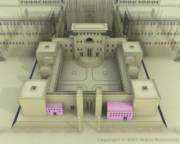
The Sanhedrin Ketanah met in a building outside the Ezrat Nashim on the Cheil. 
The stairway to the balcony is in red. 
This is a more detailed picture of the same steps.
The wall to the right is the Ulam (Porch) of the Temple. 
Detail of Azarah Proper -

The Yom Kippur Service (Avodah) within the Temple
The Yom Kippur services held within the Temple are spelled out in detail in Tractate Yoma of the Mishnah. The entire service must be conducted by the Kohan Gadol (High Priest) alone. He is drilled on the details of the service extensively for a week coming up to Yom Kippur. To understand the working of the Holy Temple this Tractate is essential. Use the accompanying illustrations to understand how the services progressed.
This building housed the Lishkat haGazit (Chamber of Hewn Stone where the Sanhedrin Gedolah sat, the Lishkat haEitz (Chamber of the Wood – the quarters for the High Priest), the Beit Kior (House of the Laver) Beit Osei Chavittim (House of the Pancake Offering Bakery), Chambers for the singers and more.
In this building there were chambers that held salt for the Korbanot, a room for processing the hides of the Korbanot for the Kohanim, and a washing chamber for rinsing the hides, a flame was kept in the building in case the fire of the Altar went out. There was a special Chamber known as the Beit Even (House of Stone) where the kohen who was going to slaughter the Red Heifer stayed the week before the ceremony. 
Also known as Beit haNitzotz. This is the location where the Kohen who was to slaughter the Red Heifer was quarantined for seven days. 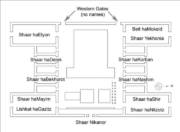
The Lishkat haGazit was within building known as the Beit Avtinas on the southeastern corner of the Azarah. This is where the Sanhedrin haGedolah met.
Detail of Azarah Proper
The wall to the right is the Ulam (Porch) of the Temple. 
Different views showing Altar and Slaughterhouse. We still have a lot to learn concerning the layout of the Slaughterhouse. -

The Honoring of a Torah Scroll
This is the story of the Torah Scroll that has come to be in our care. The story includes those that were honored to work on the Ark, Parochet and Ner Tam


id to house and treat the Torah with the proper respect.
-

The Yehoash Stone
A few years ago an inscribed plaque appeared on the Antiquities market. The stone known as the Yehoash (Jehoash, Joash) Stone is one of the most significant finds in the Archaeological World. It is the only plaque from any of the Judean Kings. The Plaque was discovered while digging a grave for a Moslem terrorist in the Moslem cemetery on the western slope of the Kidron Valley just below the Temple Mount Walls. The plaque commemorates the repairs done by Yehoash to the Temple and compliments the information we have in II Kings 12 and II Chronicles 24. The story of Yehoash is one of the most amazing reports of the First Temple Period.

First Temple Period this building was called Beit Yair haLevanon (House of the Forest of Lebanon. -

A Day in the Temple
The daily service of the Temple was described in the Tractate Tamid of the Mishnah. Complimenting this account is the Tractate Yoma. These pictures joined with the Gallery from a tour of the Temple will aid the student in understanding how the ceremony progressed.
This was the chamber where the kohanim on duty for the week slept. The two lambs for the daily Tamid were kept in the southwestern corner of the building. The Bakery for the Lechem haPanim (Bread of the Face was in the southeastern corner). The Chamber of the Tokens was in the northeastern section. In or beneath this chamber was where the stones of the desecrated altar were kept. 

This building housed the Lishkat haGazit (Chamber of Hewn Stone where the Sanhedrin Gedolah sat, the Lishkat haEitz (Chamber of the Wood – the quarters for the High Priest), the Beit Kior (House of the Laver) Beit Osei Chavittim (House of the Pancake Offering Bakery), Chambers for the singers and more.
Different views showing Altar and Slaughterhouse. We still have a lot to learn concerning the layout of the Slaughterhouse.

-

Locating the Ark of the Covenant
The quest for the Ark of the Covenant has been a hot topic for centuries. Popularized by the Indiana Jones movies, and the subject of Internet speculation, this study will look at the evidence and allow us to be fairly certain where the Ark of the Covenant was located. Theories that are commonly found are that Jeremiah hid it in a cave on Mount Nebo in Jordan, or that Solomon gave it to the Queen of Sheba and it is now located in Ethiopia. One documentary on television gave its location in South Africa and presented it as a drum. The Rabbinical texts place the Ark beneath the Temple Mount. What is the evidence and what conclusions can we draw.
This was the chamber where the kohanim on duty for the week slept. The two lambs for the daily Tamid were kept in the southwestern corner of the building. The Bakery for the Lechem haPanim (Bread of the Face was in the southeastern corner). The Chamber of the Tokens was in the northeastern section. In or beneath this chamber was where the stones of the desecrated altar were kept. 
Along the Western Retaining Wall were four gates. On the south was Robinson’s Arch, then Barclay’s Gate, then Wilson’s Arch followed by Warren’s Gate. Between Wilson’s Arch and Warren’s Gate was the Master Course. 
Locating the Master Course. 
This is a 628 ton stone and 44.6 feet long, placed on the wall nineteen feet above the Herodian Street. there are three other stones in the Master Course including a stone 7 feet long, another 39.5 feet long and the fourth at26 feet long. The stones are about fourteen feet high and between 11.5 and 15 feet thick. 
Another picture showing the height and size of the stones of the Master Course. -

Women in the Temple
While there are many aspects to women and their worship in the Temple that can be documented and help us to understand the major aspect of Jewish Temple service, it is today that so much is coming forth to enhance that knowledge. Specific sites that related to women where the Ezrat Nashim (Court of the Women), Shaar Nashim (Women’s Gate), a Mikveh and Toilet for Women. Of particular interest is the return of the Aperion (Wedding Litter) and Jerusalem of Gold crown that came back for the first time in 1992.
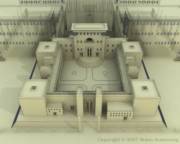
Court of the Women. One of the two Inner Courts.
The two T shaped cisterns are mikvaot. It is thought that the smaller of the two was for women. Just below the smaller mikvah is a grid of conduits. Thesee are believed to be toilets. There is a separation between the conduits were the building was obviously divided into two sections. The smaller section is believed to be for women. 
The first wedding since the destruction of the Temple using an apirion. Second night of Chanukah 1992 
The bride is borne in the Apirion by 4 litter bearers known as Gibrei Yisrael (Heroes of Israel). 
Rueven Prager of Beged Ivri was the creator of the modern Apirion. 
Mentioned in Shir haShirim and described in the Mishnah. 
This is a close up of the bottom corner of the Apirion. 
Rueven designed the upper corners to resemble the corners of the Altar. 
This article appeared in the December 1992 issue of the Jerusalem Post Magazine describing the Apirion and the coming wedding. 
This was an advertisement for the Apirion that appeared in the Jerusalem Post Magazine in December 1992. -

The Red Heifer
Before you can build a Temple or conduct Temple Services, you have to cleanse the area of the Temple from corpse impurity as described in Bamidbar (Numbers) 19. Not only will the Temple Mount have to be cleansed but also all who would participate in the services, including the kohanim (priests) Levites, and Jews entering within the Inner courtyards. The Ceremony takes seven days. The process of how this was and will be accomplished is described for us in Tractate Parah from the Mishnah as well as a corresponding Tractate Parah in the Tosefta, There are many difficulties in securing a Red Heifer, in Hebrew known as the Parah Adumah. First the heifer must be completely red, with careful inspection of even the roots of the hair inspected. In addition the cow must be free of blemishes or scars of any type. The handling of the cow must also be done with extreme care as it is very easy to disqualify the cow.
In the past ashes from previous red heifers were mixed together with a newly slain cow giving a ready supply of ashes to cleanse those requiring it. The kohanim participating in the ceremony must be free from corpse impurity. In order to accomplish this the participating kohanim were sprinkled with the available ashes. Following their sprinkling through the seven days, then they were sequestered within the Azarah in a chamber within the Beit haNtzotz (House of the Spark or Flame) known as the Beit Even (House of Stone) for an additional seven days. However, if a time arose, such as today, where the ashes of the previous heifers was not available, provision was made where women who were kohanim and pregnant would go to a house within Jerusalem, built over bedrock and arches, give birth and remain in this house until the children were ole enough to conduct the ceremony and a qualified red heifer was available.
The ceremony of the slaughtering and burning of the cow was conducted on Har haMishchah (Mount of Anointing) with a ramp (kevesh) leading from the main eastern gate (Shaar Mizrachi alav Shushan haBirah – The Eastern gate on which was depicted the Palace of Susa) to ehe location where the Heifer was to be slain. Their was a mikvah at the location as well as a room where one third of the ashes were stored. The cow crossed the ramp in front of the participating kohanim and elders of Jerusalem (Sanhedrin Members) to the location. A special pyre of wood, built like a tower (migdal) was constructed. The cow was slain, laid on the pyre with its body south to north, the head to the south and the face to the west (in the direction of the Holy of Holies). The kohen who slaughtered her stood to the east facing the west. Not only did he slaughter the heifer but was required to catch her blood. He takes the blood and faces the Temple. He is required to see the Great Gate (within the Ulam – Porch) as this is the entrance to the Heical/haKodesh (the middle room of the Temple) which was also the ohel Moed (Tent of Meeting). Using his right index finger he must dip, pop his blood soaked finger like a whip seven times towards the Ohel Moed. He must out loud count each time he whips his finger. The cow is then burnt. When the cow burst open from the fire, the kohen will toss a cedar stick wrapped with shani tolat (crimson) cloth and hyssop into the carcass of the cow, When all is burnt, other kohanim will gather the ashes, pounding the bones into dust, and collect them into a vessel made from the dung of the cow. The kohen who slaughtered and burned the heifer, was initially clean from the ceremony has now become unclean and must go to the mikvah, immerse and wait until the sun sets before he is clean again.
Several young kohanim free from corpse impurity were required to draw water for the ceremony from the Shiloach Pool at the bottom of the City of David. These young priests (at least eight years old) rode upon large doors on the backs of oxen to the pool. There they gathered the water and made the climb on the backs of the oxen to the Temple Mount. A stone pot was filled with this water, a handful of ashes were dropped on top of the water and a pine cone was lowered into the bottom of the pot. A rope was tied to the pine cone on one end while the other end was tied to a stick. The stick was placed between the horns of a ram. The ram was swatted causing him to jump, jerking his head and pulling the pine cone out of the pot, spilling water with ashes on the floor of the Temple. This ceremony required seven days. The first day a declaration was made with water spilt on the third and seventh days.
An individual who needed to be cleansed repeated the seven day process of the sprinkling described above. This is only a brief summary of the ceremony of the Red Heifer.
In this building there were chambers that held salt for the Korbanot, a room for processing the hides of the Korbanot for the Kohanim, and a washing chamber for rinsing the hides, a flame was kept in the building in case the fire of the Altar went out. There was a special Chamber known as the Beit Even (House of Stone) where the kohen who was going to slaughter the Red Heifer stayed the week before the ceremony.
Also known as Beit haNitzotz. This is the location where the Kohen who was to slaughter the Red Heifer was quarantined for seven days. 
This is the Upper Shiloach Pool. Hezekiah’s tunnel empties out into this pool. 
This si the stream that leads from the Upper Pool to the Lower Shiloach Pool. 
This photo was taken from the steps of the Lower Shiloach Pool. The Mineret in the picture marks the location of the Upper Pool 
These are steps leading down to the Lower Shiloach Pool. This pool is where the water was drawn from for the Red Heifer.
This is a more detailed picture of the same steps. 
A partial view of the immense size of the Shiloach Pool. 
The entire area in this photo was the Lower Shiloach Pool. 
This is the beginning of the road from the Shiloach Pool back to the Temple Mount. 
This red heifer candidate from 2002 failed due to white hairs in tail. 
Photo taken in a trip to inspect the 2002 Red Heifer candidate. This is Rabbi Menachem Makover 
This photo was taken in the same trip with Rabbi Makover to inspect a possible Red Heifer. 
The Grassy Knoll, our name for the location of where the Red heifer was slain. 
This is the path through the ancient cemetery leading to where Red Heifer was slain. 
Rabbi Richman teaching one of my groups from the location where the Red Heifer was slain. 

This picture gives an idea of how big the Kevesh (Bridge) was that came across the Kidron Valley to the location of where the Red Heifer was slain. 
This is the direct path that the kohen who slaughted the Red Heifer would look as he sprinkled the blood. -

Proofs of the Location of the Temple Mount
Here are some of the additional Proofs.

This is a drawing showing the location of the blowing of the Silver Trumpet from the upper corner of the Temple. Notice the trimming at the top of the stones. 
This is known as the Trumpeting Stone. It was discovered at the southwestern corner of the Temple Mount where it had fallen from above. A part of the inscription is missing as Charles Warren sheared the stone when sinking his shaft at that corner. The other part of the inscription has never been found. 
This is the actual corner stone that the Trumpeting stone set in. A plaster model of the Trumpeting stone has been set into the end of the corner stone where the original originally would have been. This corner stone was discovered in the debris at the southwestern corner of the Temple. 
This is the inside view of the Corner Stone that originally was located at the top of the southwestern corner of the Temple. 
On the Northeastern corner of the Moslem Platform, due to our calculations, was where the Beit haNitzotz should have been located. There are three cisterns located here. Two on the Moslem Platform. One is known be the Moslems as Bir haAfir (the Bird Cistern), bir Es- Suwaneh (Cistern of the Firerock), Off the Moslem Platform is another cistern known as Cistern #27. 
These are drawings by Conrad Schick done in the 1870’s for the Palestine Exploration Fund. They show the top view and cutaway view of the layout of these cisterns. 
This is a close up view of the cutaway. Notice how there is a drop in elevation. This drop in elevation is the same as the descent from the Azarah to the Ezrat Nashim (Court of the Women). 
This gives another perspective on these three Cisterns. 
There has been controversy as to whether the four corner chambers of the Ezrat Nashim were on the interior or exterior.
In the Tractate Negaim of the Mishnah we are told that there was a Mikvah below the Lishkat haMetzoraim. This chamber was on the northwestern corner of the Ezrat Nashim. 
Another drawing of the three cisterns by Conrad Schick. In this drawing he included the steps he found within the cister. This is the Mikvah below the Lishkat haMetzorim. 
Josephus described the approach from the south. There was the Soreg, followed by steps (14), then the Cheil, followed by the corner buildings. 
This is the Monumental Stairway taken in 1870 by Tyritt-Drake for the Palestine Exploration Fund. 
In 1868 Charles Warren discovered this tunnel. It in next to the northern wall of the Moslem Platform foundations. 
Here you see the tunnel discovered by Charles Warren as well as a tunnel discovered by Charles Wilson (PEF). These tunnels are described in Middot and Tamid of the Mishnah for the disqualified priests. 
This picture from Warren shows what would have been tere in the time of the Temple. The Cheil above the Tunnel. The building above is the Beit haNitzotz on the northeastern corner of the Azarah. 
This map by Charles Wilson and Charles Warren (OEF) shows the location of the Beit haTevilah for the Kohanim as described in Tamid and Middot. 
Having located the Cheil on the south and the Cheil on the north the Dome of the Rock was dead center between the two. 
This shows the major cisterns on the Mount as well as the fosse on the northwest corner.
The two T shaped cisterns are mikvaot. It is thought that the smaller of the two was for women. Just below the smaller mikvah is a grid of conduits. Thesee are believed to be toilets. There is a separation between the conduits were the building was obviously divided into two sections. The smaller section is believed to be for women. 
This is Simcha Jacobivici in a still standing building (thought to be a part of the Xystos) from the Destruction of Jerusalem.


