Blog
-

An Overview of the Hebrew Alphabet, Emunah, Interviewing Wanda Anderson, Prophets of Return: Ezra Ch. 3, Prophets of Return: Rosh HaShanah & Ezra, Chavurah August 2014
I: 08/06/14
A – An Overview of the Hebrew Alphabet
MP3
B – An Overview of the Hebrew Alphabet
MP3
II: 07/29/14 and 08/12/14
A – Emunah
MP3
B – Interviewing Wanda Anderson
MP3
III: 08/19/14
A – The Prophets of Return: Ezra Ch. 3
MP3
B – The Prophets of Return: Ezra Ch. 3
MP3
Iv: 08/26/14
A – The Prophets of Return: Rosh haShannah and Ezra
MP3
B – The Prophets of Return: Rosh haShannah and Ezra
MP3
-

The Yehoash Stone
A few years ago an inscribed plaque appeared on the Antiquities market. The stone known as the Yehoash (Jehoash, Joash) Stone is one of the most significant finds in the Archaeological World. It is the only plaque from any of the Judean Kings. The Plaque was discovered while digging a grave for a Moslem terrorist in the Moslem cemetery on the western slope of the Kidron Valley just below the Temple Mount Walls. The plaque commemorates the repairs done by Yehoash to the Temple and compliments the information we have in II Kings 12 and II Chronicles 24. The story of Yehoash is one of the most amazing reports of the First Temple Period.


First Temple Period this building was called Beit Yair haLevanon (House of the Forest of Lebanon. -

A Day in the Temple
The daily service of the Temple was described in the Tractate Tamid of the Mishnah. Complimenting this account is the Tractate Yoma. These pictures joined with the Gallery from a tour of the Temple will aid the student in understanding how the ceremony progressed.

This was the chamber where the kohanim on duty for the week slept. The two lambs for the daily Tamid were kept in the southwestern corner of the building. The Bakery for the Lechem haPanim (Bread of the Face was in the southeastern corner). The Chamber of the Tokens was in the northeastern section. In or beneath this chamber was where the stones of the desecrated altar were kept. 

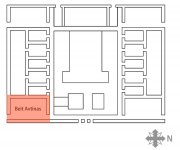
This building housed the Lishkat haGazit (Chamber of Hewn Stone where the Sanhedrin Gedolah sat, the Lishkat haEitz (Chamber of the Wood – the quarters for the High Priest), the Beit Kior (House of the Laver) Beit Osei Chavittim (House of the Pancake Offering Bakery), Chambers for the singers and more. 


Different views showing Altar and Slaughterhouse. We still have a lot to learn concerning the layout of the Slaughterhouse. 


-

Locating the Ark of the Covenant
The quest for the Ark of the Covenant has been a hot topic for centuries. Popularized by the Indiana Jones movies, and the subject of Internet speculation, this study will look at the evidence and allow us to be fairly certain where the Ark of the Covenant was located. Theories that are commonly found are that Jeremiah hid it in a cave on Mount Nebo in Jordan, or that Solomon gave it to the Queen of Sheba and it is now located in Ethiopia. One documentary on television gave its location in South Africa and presented it as a drum. The Rabbinical texts place the Ark beneath the Temple Mount. What is the evidence and what conclusions can we draw.
This was the chamber where the kohanim on duty for the week slept. The two lambs for the daily Tamid were kept in the southwestern corner of the building. The Bakery for the Lechem haPanim (Bread of the Face was in the southeastern corner). The Chamber of the Tokens was in the northeastern section. In or beneath this chamber was where the stones of the desecrated altar were kept. 
Along the Western Retaining Wall were four gates. On the south was Robinson’s Arch, then Barclay’s Gate, then Wilson’s Arch followed by Warren’s Gate. Between Wilson’s Arch and Warren’s Gate was the Master Course. 
Locating the Master Course. 
This is a 628 ton stone and 44.6 feet long, placed on the wall nineteen feet above the Herodian Street. there are three other stones in the Master Course including a stone 7 feet long, another 39.5 feet long and the fourth at26 feet long. The stones are about fourteen feet high and between 11.5 and 15 feet thick. 
Another picture showing the height and size of the stones of the Master Course. -

Women in the Temple
While there are many aspects to women and their worship in the Temple that can be documented and help us to understand the major aspect of Jewish Temple service, it is today that so much is coming forth to enhance that knowledge. Specific sites that related to women where the Ezrat Nashim (Court of the Women), Shaar Nashim (Women’s Gate), a Mikveh and Toilet for Women. Of particular interest is the return of the Aperion (Wedding Litter) and Jerusalem of Gold crown that came back for the first time in 1992.
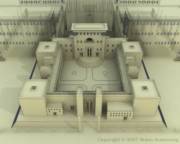
Court of the Women. One of the two Inner Courts. 
The two T shaped cisterns are mikvaot. It is thought that the smaller of the two was for women. Just below the smaller mikvah is a grid of conduits. Thesee are believed to be toilets. There is a separation between the conduits were the building was obviously divided into two sections. The smaller section is believed to be for women. 
The first wedding since the destruction of the Temple using an apirion. Second night of Chanukah 1992 
The bride is borne in the Apirion by 4 litter bearers known as Gibrei Yisrael (Heroes of Israel). 
Rueven Prager of Beged Ivri was the creator of the modern Apirion. 
Mentioned in Shir haShirim and described in the Mishnah. 
This is a close up of the bottom corner of the Apirion. 
Rueven designed the upper corners to resemble the corners of the Altar. 
This article appeared in the December 1992 issue of the Jerusalem Post Magazine describing the Apirion and the coming wedding. 
This was an advertisement for the Apirion that appeared in the Jerusalem Post Magazine in December 1992. -

Temple Ceremonies: Daily Services Vol3/4 MP3 – 4 Parts
Part 1A
Part1B
Part 2A
Part2B
Part 3A
Part3B
Part 4A
Part 4B
-

The Red Heifer
Before you can build a Temple or conduct Temple Services, you have to cleanse the area of the Temple from corpse impurity as described in Bamidbar (Numbers) 19. Not only will the Temple Mount have to be cleansed but also all who would participate in the services, including the kohanim (priests) Levites, and Jews entering within the Inner courtyards. The Ceremony takes seven days. The process of how this was and will be accomplished is described for us in Tractate Parah from the Mishnah as well as a corresponding Tractate Parah in the Tosefta, There are many difficulties in securing a Red Heifer, in Hebrew known as the Parah Adumah. First the heifer must be completely red, with careful inspection of even the roots of the hair inspected. In addition the cow must be free of blemishes or scars of any type. The handling of the cow must also be done with extreme care as it is very easy to disqualify the cow.
In the past ashes from previous red heifers were mixed together with a newly slain cow giving a ready supply of ashes to cleanse those requiring it. The kohanim participating in the ceremony must be free from corpse impurity. In order to accomplish this the participating kohanim were sprinkled with the available ashes. Following their sprinkling through the seven days, then they were sequestered within the Azarah in a chamber within the Beit haNtzotz (House of the Spark or Flame) known as the Beit Even (House of Stone) for an additional seven days. However, if a time arose, such as today, where the ashes of the previous heifers was not available, provision was made where women who were kohanim and pregnant would go to a house within Jerusalem, built over bedrock and arches, give birth and remain in this house until the children were ole enough to conduct the ceremony and a qualified red heifer was available.
The ceremony of the slaughtering and burning of the cow was conducted on Har haMishchah (Mount of Anointing) with a ramp (kevesh) leading from the main eastern gate (Shaar Mizrachi alav Shushan haBirah – The Eastern gate on which was depicted the Palace of Susa) to ehe location where the Heifer was to be slain. Their was a mikvah at the location as well as a room where one third of the ashes were stored. The cow crossed the ramp in front of the participating kohanim and elders of Jerusalem (Sanhedrin Members) to the location. A special pyre of wood, built like a tower (migdal) was constructed. The cow was slain, laid on the pyre with its body south to north, the head to the south and the face to the west (in the direction of the Holy of Holies). The kohen who slaughtered her stood to the east facing the west. Not only did he slaughter the heifer but was required to catch her blood. He takes the blood and faces the Temple. He is required to see the Great Gate (within the Ulam – Porch) as this is the entrance to the Heical/haKodesh (the middle room of the Temple) which was also the ohel Moed (Tent of Meeting). Using his right index finger he must dip, pop his blood soaked finger like a whip seven times towards the Ohel Moed. He must out loud count each time he whips his finger. The cow is then burnt. When the cow burst open from the fire, the kohen will toss a cedar stick wrapped with shani tolat (crimson) cloth and hyssop into the carcass of the cow, When all is burnt, other kohanim will gather the ashes, pounding the bones into dust, and collect them into a vessel made from the dung of the cow. The kohen who slaughtered and burned the heifer, was initially clean from the ceremony has now become unclean and must go to the mikvah, immerse and wait until the sun sets before he is clean again.
Several young kohanim free from corpse impurity were required to draw water for the ceremony from the Shiloach Pool at the bottom of the City of David. These young priests (at least eight years old) rode upon large doors on the backs of oxen to the pool. There they gathered the water and made the climb on the backs of the oxen to the Temple Mount. A stone pot was filled with this water, a handful of ashes were dropped on top of the water and a pine cone was lowered into the bottom of the pot. A rope was tied to the pine cone on one end while the other end was tied to a stick. The stick was placed between the horns of a ram. The ram was swatted causing him to jump, jerking his head and pulling the pine cone out of the pot, spilling water with ashes on the floor of the Temple. This ceremony required seven days. The first day a declaration was made with water spilt on the third and seventh days.
An individual who needed to be cleansed repeated the seven day process of the sprinkling described above. This is only a brief summary of the ceremony of the Red Heifer.

In this building there were chambers that held salt for the Korbanot, a room for processing the hides of the Korbanot for the Kohanim, and a washing chamber for rinsing the hides, a flame was kept in the building in case the fire of the Altar went out. There was a special Chamber known as the Beit Even (House of Stone) where the kohen who was going to slaughter the Red Heifer stayed the week before the ceremony. 
Also known as Beit haNitzotz. This is the location where the Kohen who was to slaughter the Red Heifer was quarantined for seven days. 
This is the Upper Shiloach Pool. Hezekiah’s tunnel empties out into this pool. 
This si the stream that leads from the Upper Pool to the Lower Shiloach Pool. 
This photo was taken from the steps of the Lower Shiloach Pool. The Mineret in the picture marks the location of the Upper Pool 
These are steps leading down to the Lower Shiloach Pool. This pool is where the water was drawn from for the Red Heifer. 
This is a more detailed picture of the same steps. 
A partial view of the immense size of the Shiloach Pool. 
The entire area in this photo was the Lower Shiloach Pool. 
This is the beginning of the road from the Shiloach Pool back to the Temple Mount. 
This red heifer candidate from 2002 failed due to white hairs in tail. 
Photo taken in a trip to inspect the 2002 Red Heifer candidate. This is Rabbi Menachem Makover 
This photo was taken in the same trip with Rabbi Makover to inspect a possible Red Heifer. 
The Grassy Knoll, our name for the location of where the Red heifer was slain. 
This is the path through the ancient cemetery leading to where Red Heifer was slain. 
Rabbi Richman teaching one of my groups from the location where the Red Heifer was slain. 

This picture gives an idea of how big the Kevesh (Bridge) was that came across the Kidron Valley to the location of where the Red Heifer was slain. 
This is the direct path that the kohen who slaughted the Red Heifer would look as he sprinkled the blood.


