Blog
-

The Yom Kippur Service (Avodah) within the Temple
The Yom Kippur services held within the Temple are spelled out in detail in Tractate Yoma of the Mishnah. The entire service must be conducted by the Kohan Gadol (High Priest) alone. He is drilled on the details of the service extensively for a week coming up to Yom Kippur. To understand the working of the Holy Temple this Tractate is essential. Use the accompanying illustrations to understand how the services progressed.
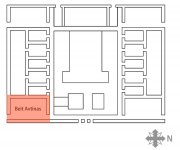
This building housed the Lishkat haGazit (Chamber of Hewn Stone where the Sanhedrin Gedolah sat, the Lishkat haEitz (Chamber of the Wood – the quarters for the High Priest), the Beit Kior (House of the Laver) Beit Osei Chavittim (House of the Pancake Offering Bakery), Chambers for the singers and more. 
In this building there were chambers that held salt for the Korbanot, a room for processing the hides of the Korbanot for the Kohanim, and a washing chamber for rinsing the hides, a flame was kept in the building in case the fire of the Altar went out. There was a special Chamber known as the Beit Even (House of Stone) where the kohen who was going to slaughter the Red Heifer stayed the week before the ceremony. 
Also known as Beit haNitzotz. This is the location where the Kohen who was to slaughter the Red Heifer was quarantined for seven days. 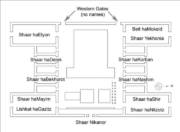
The Lishkat haGazit was within building known as the Beit Avtinas on the southeastern corner of the Azarah. This is where the Sanhedrin haGedolah met. 

Detail of Azarah Proper 
The wall to the right is the Ulam (Porch) of the Temple. 
Different views showing Altar and Slaughterhouse. We still have a lot to learn concerning the layout of the Slaughterhouse. -

In the Footsteps of the Messiah – TV Series: 01/02
01 – The Chosen People
02 – The 7,000 Year Plan of G-d
-

The Journey of a Torah, What does Yeshua’s Birth have to do with Gog & Magog?, Trial of Yeshua-Sanhedrin Part 1-2, Chavurah October 2014
I: 09/30/14
A – The Journey of a Torah
B – The Journey of a Torah
II: 10/05/14
A – What does Yeshua’s birth have to do with Gog n Magog?
B – What does Yeshua’s birth have to do with Gog n Magog?
III: 10/21/14
A – Trial of Yeshua – Sanhedrin?
B – Trial of Yeshua – Sanhedrin?
IV: 10/28/14
A – Trial of Yeshua – Sanhedrin? Part 2
B – Trial of Yeshua – Sanhedrin? Part 2
-

The Honoring of a Torah Scroll
This is the story of the Torah Scroll that has come to be in our care. The story includes those that were honored to work on the Ark, Parochet and Ner Tam


id to house and treat the Torah with the proper respect.
-

The Mishpachah TV Series – Programs 21-23: Rosh haShanah
21 – Rosh haShanah Part 1
22 – Rosh haShanah Part 2
23 – Rosh haShahah Part 3
-

Temple Ceremonies: Daily Services Vol4/4 MP3 – 4 Parts
Part 1A
Part1B
Part 2A
Part2B
Part 3A
Part3B
Part 4A
Part 4B
-
Prophets of Return: the Name, Prophets of Return: The Elders, Enactments of the Great Assembly, The names of Rosh HaShanah, Chavurah September 2014
I: 09/02/14
A – The Prophets of Return: The Name
B – The Prophets of Return: The Name
II: 09/09/14
A – The Prophets of Return: The Elders
B – The Prophets of Return: The Elders
III: 09/16/14
A – Enactments of the Great Assembly
B – Enactments of the Great Assembly
IV: 09/23/14
A – The Names of Rosh haShanah
B – The Names of Rosh haShanah
-
The Sanhedrin and its importance to the Torah and Temple
The Lishkat haGazit was within building known as the Beit Avtinas on the southeastern corner of the Azarah. This is where the Sanhedrin haGedolah met. 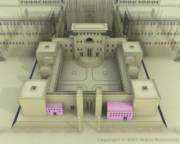
The Sanhedrin Ketanah met in a building outside the Ezrat Nashim on the Cheil. 
The Beit Din Gadol met outside the Temple Compound east of the Southern Steps. 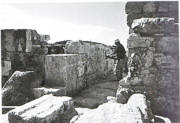
Constructed in typical Herodian style, looking northeast 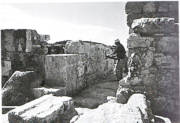
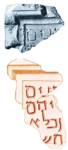
Two connecting fragments of a Hebrew inscription found at the foot of the triple Gate. The word elders can be read in the inscription, believed to refer to the elders of the Sanhedrin 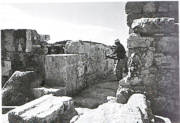
This is the entrance into the building of the Beit din Gadol The Sanhedrin, instituted within the Torah, was the Supreme Court of Israel. There were three levels of this highest level of the Judicial System. The highest was known as the Sanhedrin Gedolah (the Great Sanhedrin) and they met within the Lishkat haGazit (the Chamber of Hewn Stone) which was within the Beit Avtinas (House of Avtinas). This building was located on the southeastern corner of the Azarah (the Inner Courtyard of the Temple). The building was divided into two sections. The section closest to the Azarah was the sanctified section of the building while the section closest to the Cheil (the 10 cubit wide stabilizing platform that surrounded the buildings and gates adjoining the Azarah) was the unsanctified section. The Cheil had a lower sanctity than the Azarah. In the unsanctified section of the building is where the Sanhedrin Gedolah sat. The overall building (Beit Avtinas) had the kedushah (sanctity) of the Azarah. There were 71 judges to the Sanhedrin Gedolah.
The second court, the Sanhedrin Ketanah (the Smaller Sanhedrin) sat in the Cheil outside the eastern gate of the Ezrat Nashim (Court of the Women). This court had 23 judges and tried cases not requiring death penalties.
The third court sat off the Temple Mount just to the east of the Southern Steps and was known as the Beit Din haGadol (the Great Beit Din – House of Judgment). This building was located with a portion of the plaque that was on the building. The court had 3 judges.
This building housed the Lishkat haGazit (Chamber of Hewn Stone where the Sanhedrin Gedolah sat, the Lishkat haEitz (Chamber of the Wood – the quarters for the High Priest), the Beit Kior (House of the Laver) Beit Osei Chavittim (House of the Pancake Offering Bakery), Chambers for the singers and more. 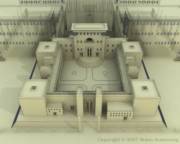
Court of the Women. One of the two Inner Courts. 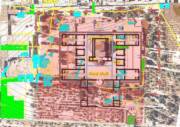
The Red Area shows location of Original Temple Mount.


